Know exactly why they left.
WhyLeft asks every customer who cancels why — and turns the answers into the one thing worth fixing next.

A cancelled customer is the most honest person in your funnel. Almost nobody ever asks them.
The second question is the one that matters
“Too expensive” is where feedback normally stops. WhyLeft asks what it was too expensive for — and gets the answer that changes your roadmap instead of your price.
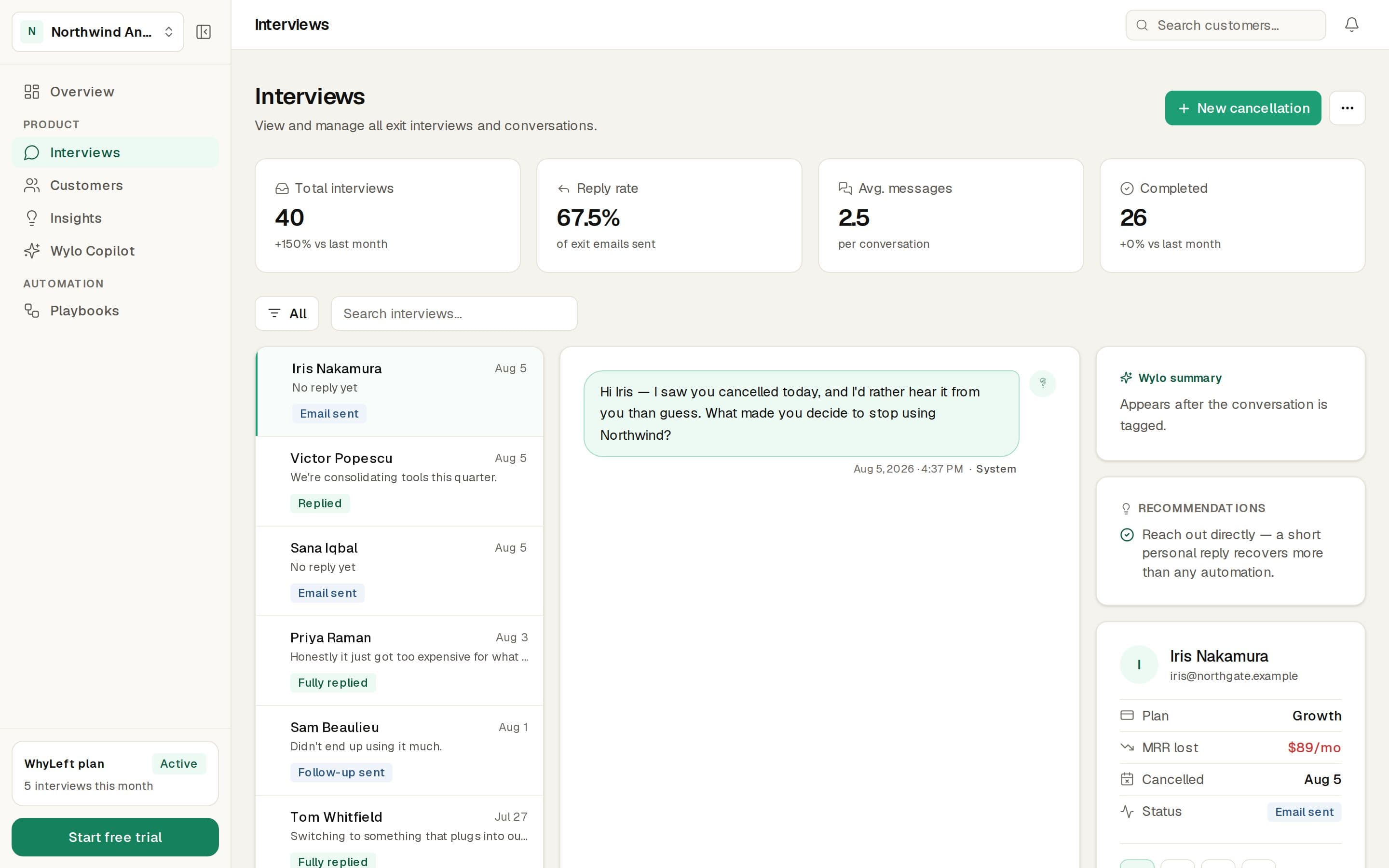
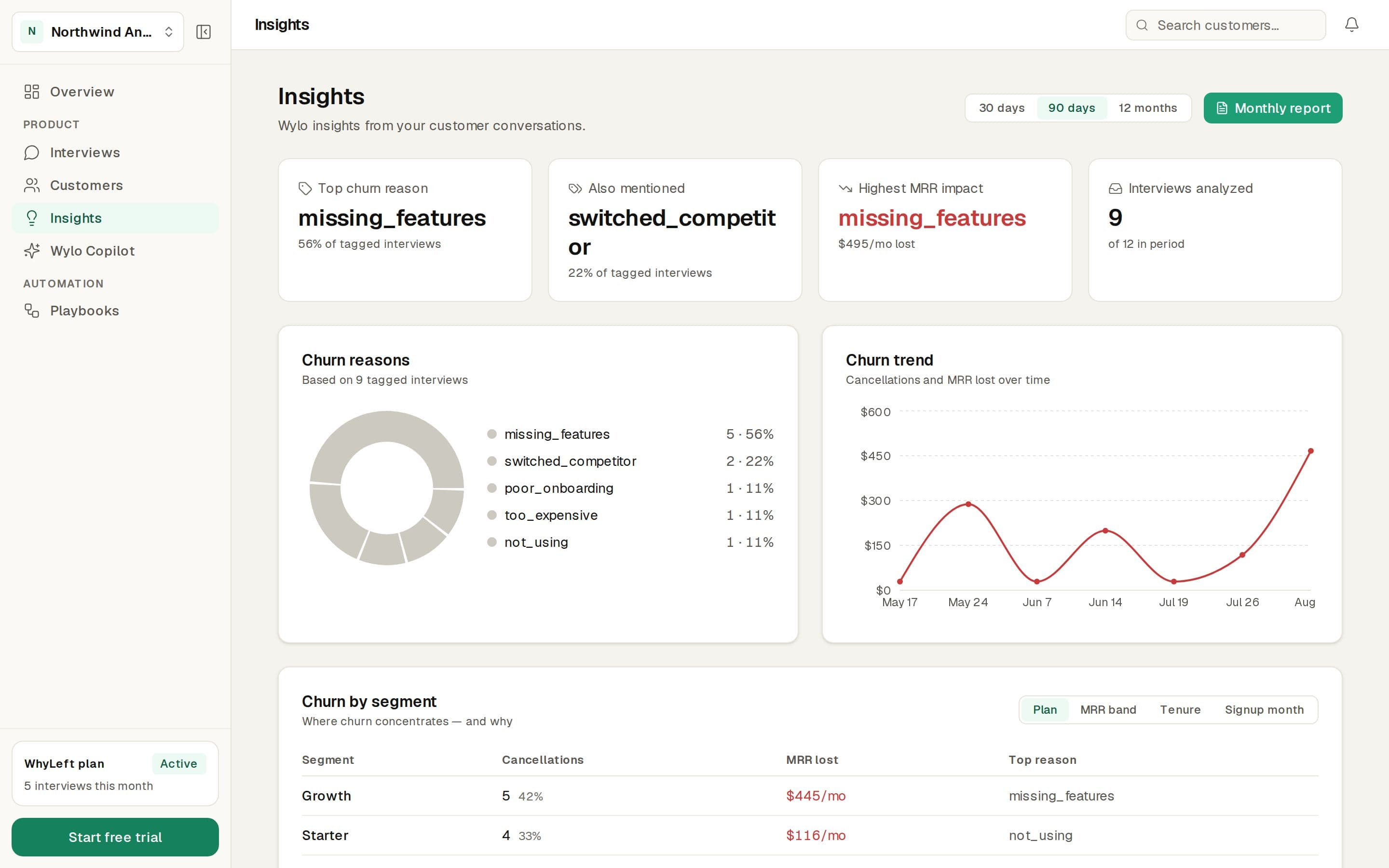
Forty conversations, one thing to fix
Every reply is tagged and read against everything else you have heard. What comes back is not a chart to interpret — it is a recommendation, with the quotes and the MRR behind it.
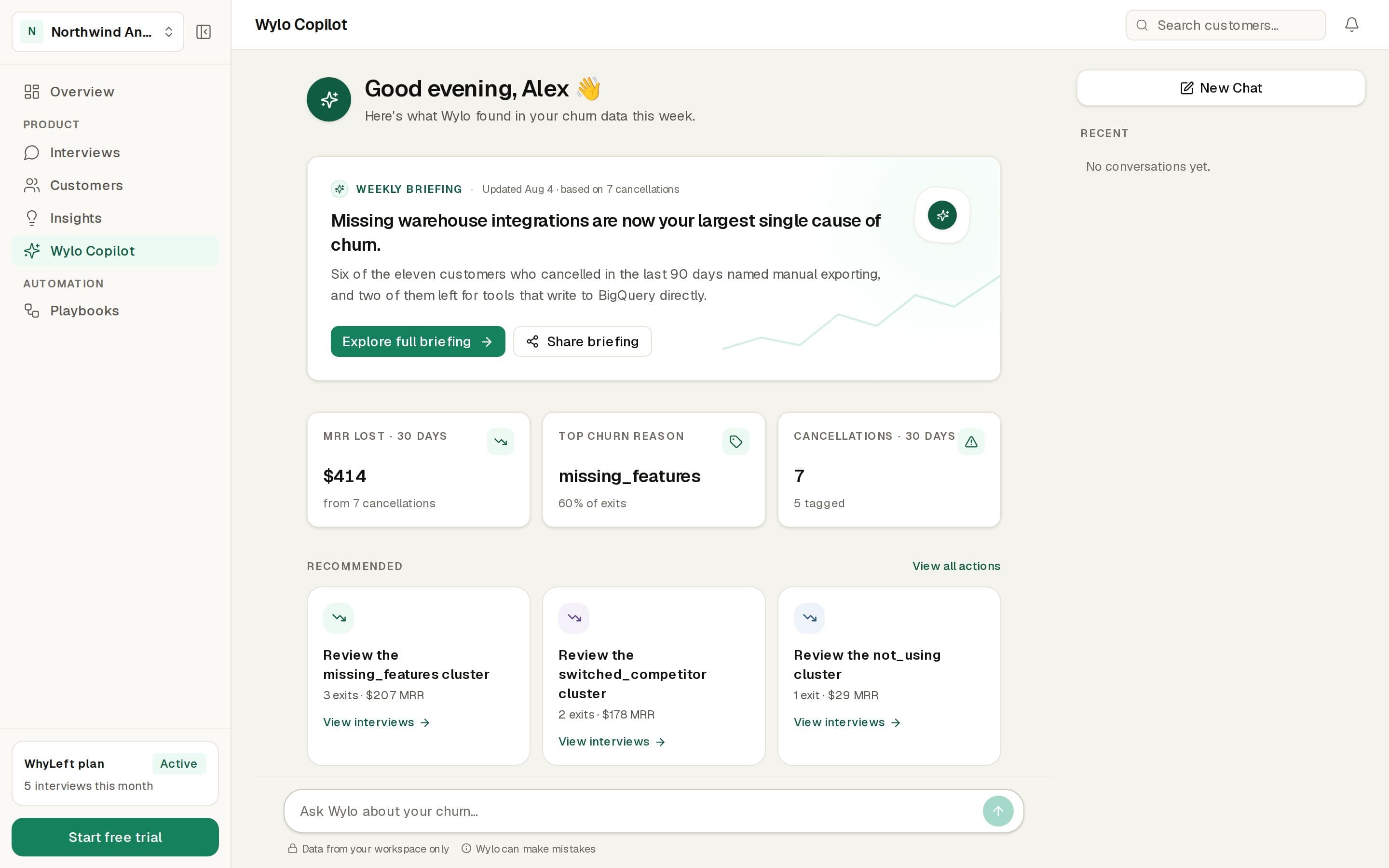
Then ask it anything
Wylo reads every interview you have ever collected. Ask why enterprise churn doubled last quarter and it answers from your own customers' words.


Three things change the day you turn it on
A cancellation stops being a notification
It arrives with a reason attached, in their words.
A roadmap call stops being a hunch
The thing to fix comes ranked by the revenue behind it.
A churned customer stops being gone
When you fix their reason, they hear it from you.
Everything, on every plan
One price, no feature gates — including the capabilities that ship next year.
No customer quotes here yet
When a customer says something worth quoting and lets us publish it, their post appears here — their name, their link. Inventing one would be a strange way to sell a product built on honest answers.
“We run WhyLeft on WhyLeft. When you cancel, you get the exit interview — same email, same follow-up. It would be strange to sell a product I wasn't willing to point at myself.”
 SamirFounder, WhyLeft
I got tired of guessing why people left
I'm Samir. For years I watched the cancellation email arrive, felt bad for a minute, and moved on. When I did write back, people almost always answered — and it was almost never what I'd assumed.
Asking took ten minutes I didn't have, at the moment I least wanted to spend them. So I built the thing that asks.
Questions founders ask first
Will my customers know it's automated?
The email is plain text, sent from your address, signed with your name, with no tracking pixel, no logo, no survey link and no unsubscribe footer beyond the legally required one-click header. It arrives minutes after they cancel, which is exactly when a founder would have written it.
When they reply, the reply goes into a real conversation. Most people never think about it.
Will people actually reply?
More than reply to a survey link — because it isn't one. It's one question from a human address that they can answer by hitting reply, without leaving their inbox or loading a form.
We don't publish a promised reply rate, because yours will depend on your product, your relationship with your customers and how you word the question. You'll see your own rate in the dashboard from your first cancellation.
How long does setup actually take?
About five minutes. You connect your billing provider, confirm the name and address your exit emails send from, and write one or two sentences describing what your product does so the AI has context.
There's no code to deploy, no snippet to install, and no data migration. The next customer who cancels gets an interview.
Does my customers' personal data go to the AI?
No. Automated AI processing — tagging, follow-up generation, insights, recommendations — receives the reply text and non-identifying metadata only: plan, price, dates, churn tags. Never a name, never an email address.
The one exception is deliberate and founder-controlled: when you personally ask Wylo Copilot a question about a specific customer, it can retrieve that customer's identity — inside your own authenticated workspace only, through the same authorization boundary as your dashboard.
Which billing providers work with WhyLeft?
Stripe, Polar, Lemon Squeezy and Paddle are detected automatically — connect the account and cancellations start flowing.
Anything else works through the API, an outbound webhook from your own backend, manual entry, or a CSV import. The billing provider is a convenience, not a requirement.
How many emails does a cancelled customer get?
At most two: the exit interview and one follow-up. That cap is enforced in code, not by policy — the send path checks it before every message.
Win-back emails are a separate, opt-in flow that only goes to customers whose stated reason you've actually addressed.
Your next cancellation is coming.
It can be another number on a chart, or the reason you build the right thing next quarter.
No credit card. Cancel in one click — we'd rather you tell us why.